Saturday, July 31, 2010

Colour Objects Assignment (from Observation) and Colour Theory Information

Most of the examples of colour object drawings posted below demonstrate drawing with local colour through a process of layering, colour mixing and editing. Some also demonstrate a depiction of coloured objects with thematic content. For this assignment high lights and shadows should be used but no black should be used to depict shadows.

Editing and Layering with Mediums:
When editing and layering mediums it is extremely important to research and investigate different mediums in terms of what allows for a maximum use of colour mixing. As well research, experiment and investigate on test sheets to determine which drawing mediums are transparent and which drawing mediums are opaque. The opaque drawing materials and mediums will be very useful for covering (layering over) "mistakes". Overall some mediums work better over some than others. For example oil pastel can be used on top of any medium (provided that medium is dry or has dried) but in terms of editing or layering over oil pastel there is not any medium that can be layered on top of oil pastel. So scraping will be required to remove unwanted oil pastel. Experiment and investigate to see how mediums interact when different mediums are combined. You will be required to take risks in order to have progress with this project and other project in the course.


Assignment Objectives:
The majority of examples below demonstrate observational drawing using strategic use of colour (colour in relation to mixing and considering full ranges of hues: primary, secondary, tertiary colours, as well as tints, neutrals, complimentary and analogous colour systems, pure/intense and muted colour) Most of the posted examples demonstrate a focus on local colour with the optical mixing or physical mixing of colour systems.

In addition to the strategic use of colour, selective use of detail, contrast (and lack of contrast), range of sharp and soft edges are all used to convey spatial characteristics of the objects.

Proportions will be a consideration but thematic content, illusion of local colour, mass and space will be the primary concerns for the thematic colour objects drawing assignment. The drawing must contain a strong sense of thematic content with objects communicating substantial meaning and or layers of metaphor and or symbols and or narrative, etc. (see description of thematic content from the "What is Contemporary Art Assignment?" from beginning of course)"What is Contemporary Art?"

This assignment should not present any cliche imagery or ideas. This assignment is about trying to depict still-life in a representational (realistic) way with objects that have substantial thematic content. It is important for everyone in this assignment to strive and eventually achieve layered thematic content in a unique way.


Oil Pastel


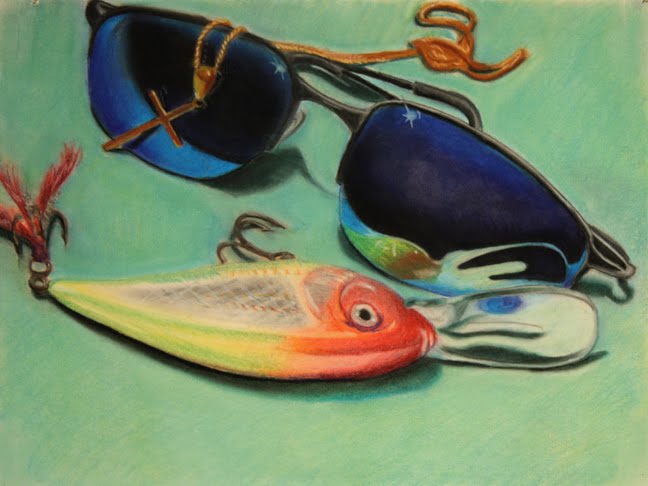
This Chalk Pastel above is a good example of objects with thematic (or in this case symbolic) content. The crucifix is a loaded icon which in this example might be used in a slightly cliche sort of manner and formally there is far too much use of black, but the composition is very good. Overall the the objects collectively begin to convey a good thematic drawing.


Chalk Pastel and Conte
The above example is a very good start for a thematic drawing. Issues of gender, conflict and perhaps power and wealth are presented in the above work.


The five examples of colour object drawings posted below convey very little in terms of thematic content but do demonstrate drawing with local colour through a process of layering, colour mixing and editing.

The majority of examples demonstrate a strategic use of colour (colour in relation to mixing and considering full ranges of hues: primary, secondary, tertiary colours, as well as tints, neutrals, complimentary and analogous colour systems, pure and muted colour) Most of the posted examples demonstrate a focus on local colour with the optical mixing or physical mixing of colour systems.

In addition to the strategic use of colour, selective use of detail, range of sharp and soft edges are used to convey spatial characteristics of the objects.

Proportions will be a consideration but thematic content, illusion of local colour, mass and space will be the primary concerns for the thematic colour objects drawing assignment.


Below is Information Regarding Colour and Colour Theory that is applicable to the Thematic Colour Objects Assignment and is also applicable to all future colour assignments in the course:


The Double Primary Colour Wheel and Information on Colour

The Double Primary Colour Wheel below presents 3 rings of colour along with the warm and cool primaries (double primaries). The two inner rings of the wheel are colours created by mixing various percentages of complimentary colours. These neutral colours that are derived from mixing complimentary colours can allow for a huge range of options when considering colours for shadows and variations of light when depicting planes and mass. In most cases black will not be required if these neutral colours and analogous colours are considered.


Additional Information regarding colour theory and colour systems that should be used in all assignments for class:

Definitions


Complimentary Colour: Hues that are located directly across each other on the colour wheel. When complimentary colours are placed beside each other they optically create a greater sense of intensity. This allows for greater contrast within an area of a drawing/painting. When the complimentary colours are mixed this neutralizes any hue and the intensity of the hue decreases, which may also be used to decrease contrast within an area of a painting. Collectively this becomes essential to a drawing/painting when considering the "push and pull" of colour and shapes within a drawing/painting.


Analagous Colour: Hues that are beside each other on the colour wheel. - Often this colour system can replace or augment the use of white (tinting hues) or when using neutrals (such as browns, grays, blacks, etc) Overall the use of analagous colour presents a sophisticated approach when depicting highlights or shadows in the hue of a coloured shape or space. When using the proper primaries (as demonstrated in the double primaries colour wheel) analgous colours/hues will maintain their intensity.


Value in Colour


Value and Intensity


Three Dimensional Model illustrating what is often considered the three characteristics of colour (Hues, Neutrals and Value)


Mixing Black (and other Neutrals) into pure hues of colour


For further information on colour mixing and colour theory see:


AND

Blindfold Drawings

Supplies Required:
• Some sort of blindfold (anything that will completely block your
eyesight while you draw)

• Chalk or Oil pastels (preferably oil pastel – if using oil pastel you
will need something to scrape and scratch the oil pastel away)

• Charcoal

• Rubber Eraser for subtracting chalk pastel, charcoal, chalk line
dust, or graphite powder. As well pencils, markers, and coloured pencils

• Stencils and Templates (as shown in class):
An assortment of organic and geometric stencils and templates at
various scales should be used to maximize the shape variations and
compositions in your drawings. Some stencils/templates should be
considerably larger than your hand while others may be same size and
smaller than your hand.

To make stencils: cut out (or tear) shapes in materials such as paper and or cardboard (the shaped hole in the material is the stencil, the shape removed from the material to create the shaped hole is the template). Geometric shapes may include squares, rectangles, circles and triangles and a combination of those shapes. As well organic shapes may include blob shapes and/or bean shapes and/or asymmetrical clover shapes. Or you may find some ready made stencils or templates that are abstract. The more ambiguous and abstract the stencil is the more successful your drawing will be in reaching the assignment objectives. As you draw blind folded you will feel each cut out stencil and template to trace and layer shapes in your drawing using an additive and subtractive process.

• White or off-white paper, 18 x 24 inches minimum in size, 3-4 sheets
of drawing paper (white cartridge paper is suggested but it is only one
option in terms of white or off-white paper).

• (Optional) Chalk line dust or graphite powder – if you use either of
these mediums bring a dust mask.

Student Examples and Historical Reference:
Further explanations will be given in class that will include some
examples of previous students work (as shown in the class powerpoint presentation) and historical examples by Robert
Morris
’s Blind Time Drawings (Began series Circa 1970s).

Purpose of Assignment:
• Increase the awareness of other senses. In particular this assignment
focuses on the sense of; touch, the variety of pressures applied to
drawing tools, and the emphasized awareness of arm, hand and finger
movements while drawing.

• Becoming aware of one’s own body in relation to drawing.

• Becoming sensitized to the physicality of drawing mediums and to the
physical variations of the layers in a drawing.

• Allow chance to take place and letting unexpected accidents to happen
which will give new ways of approaching drawing when considering formal
issues of abstraction. Overall this is opening up the possibility for
intuition and instincts to play a greater role in the drawing process.

• Offer students a variety of options/alternatives to their usual
system of drawing and or to traditional methods of drawing.


Evaluation criteria:

Variation of interesting stencil and template shapes

Variation of drawing materials

Maximized layering process in major parts of drawing

Physical presence of materials on surface

Variation of mark making

Experimentation and innovation

Overall uniqueness

COLOUR ABSTRACTION and COLLAGE

Revisiting the formal, pure and physical languages within the drawing and painting disciplines
 
Assignment and Objectives:
Complete a  drawing  that emphasize concepts demonstrating the language of drawing (the physical act of drawing with traditional drawing materials as a language in itself). The work should try to demonstrate a variety of formal concerns in the picture plane such as the use of colour, shapes, scale shifts, composition and mark making using primarily drawing materials. You have the option of developing collaged materials into the drawing. All attempts should be made in the drawing assignment to not reference anything representational.

1) Your drawing should consist of as many forms and spaces as possible with a complex but unified composition in each work. Consider intervals between elements and allow for focal points where there are areas of multiple overlapping shapes that interact with each other while simultaneously interacting within the overall composition.

2) Space should vary from deep to shallow with a variety of line and shapes. Also consider variations of visual weight in the line and shapes.

3) Avoid literal or conventional methods to depict shallow and deep spaces. Spaces and forms can be fragmented and or abstracted through experimentation with drawing materials.

4) Consider the reality of the drawing medium (language of the medium) on the 2 dimensional surface of your picture plane. (thick and thin applications of drawing mediums and mark making) and consider your options in terms of a surface. Some areas will require numerous layers of drawing materials while other areas will work with minimal applications of materials. As well during the drawing process some areas of the drawings should involve scraping and erasing.

Suggested Drawing Materials:
It is suggested people use the coloured oil bars for this assignment but many other options are also available in conjunction with the oil bars. Drawing materials such as oil or chalk pastels that cover large areas of your drawing quickly and offer good colour and have strong physical presence on the drawing surface allowing for an investigation of mark making will also work as well. Over all you can use all other types of coloured drawing materials for detail work such as coloured pencils, coloured inks and coloured markers, but keep in mind these should not be your primary drawing tools since they do not cover a large area quickly nor do they offer any sort of physicality in terms of the mediums presence or mark making. As well you may use acrylic or watercolour as a base or intermittently as long as the work emphasizes drawing materials. It is recommended that you use a fairly thick paper as your drawing surface. Some people have used canvas in the past but keep in mind the texture of the canvas causes the drawing materials to erode and ware out considerably quicker than if paper was used for a drawing surface. This 3 x 4 feet work can be one large sheet of paper or it may be smaller sheets of paper joined together. Consider how the seems of smaller paper will be integrated into the drawing and or hidden in the drawing.

Studies or Smaller Preliminary Works:
The purpose of the studies is to assist you in the investigation of this assignment. All the objectives do not have to be met in each study but rather should be used to take risks and experiment with to find all the required objectives. The studies are not about making something small and then duplicating that small study at a large scale. Instead the studies and the larger work should feed off each other. During the process there should be a back and forth of working between the studies and the large work (especially at the beginning stages of the drawing) As well studies may include manipulations of digital photos of the large work taken while in progress. In general it is strongly recommended that you photograph the work in progress and periodically make some inexpensive prints at home to work on in order to consider all potential directions to develop the work. Overall experiment and investigate various options thoroughly with the studies and the large work.

Steps of Process to Consider for Developing Drawing(s):
Avoid having every formal and conceptual component of your drawing pre-planned or “figured out” before you begin. This will eventually suffocate any desire to work, because it is almost impossible to pre-plan every step in the process and get positive results.

If you are stuck with no ideas it is best to immediately start drawing with vague ideas and some random organic and geometric shapes such as in some of the examples posted below.

Prepare yourself mentally for a process of: risk, unexpected direction, layering, reworking, researching, making small preliminary works, applying criticism, generally experimenting with conviction in your drawing, and you will have a very successful work or series of works.

Optional Readings (Assistance in developing assignment):
Also there is the option to consider excerpts from Search for the Real a small book by Hans Hofmann, or excepts from survey books such as Art Speak by Robert Atkins (small book), The Visual Arts: a history by Hugh Honour and John Fleming, 7th edition p 844, and essays: Modernist Painting by Clement Greenberg. Considering the Hofmann, Atkins, Honour/Fleming and Greenberg's readings may assist you when developing ideas in your drawing.

For a broader view outside the modernist drawing assignment objectives other texts such as Art of the Postmodern Era, by Irving Sandler, Contemporary Art: Art since 1970 by Brandon Taylor, Five Faces of Modernity by Matei Calinescu and essay: Action Painting: Crisis and Distortion by Harold Rosenberg. These other texts offer debates, alternatives and opposition to Greenberg’s ideas regarding Modernism.


EXAMPLES for GUIDANCE
The examples presented here for the Modernist assignment are meant as a guide. Not all examples below meet all of the objectives for the assignment but instead offer a range of partial ideas that can be cohesively comprehended, synthesized and applied to the specific requirements of the modernist assignment in a unique and innovative manner.

For additional student examples of a similar assignment from my painting courses please view the following link:

an excellent study that is 18 x 24 inches (studies for this assignment may be smaller and hopefully a little less floral with less spiral shapes)


an excellent study that is 18 x 24 inches (studies for this assignment may be smaller and hopefully a little less floral with less spiral shapes)


Advanced Painting 4 x 4 feet mixed media and paint on collaged paper Spring 2005


Advanced Painting 4 x 4 feet mixed media and paint on collaged paper Spring 2005


Advanced Painting 4 x 4 feet mixed media and paint on collaged paper Spring 2005


Advanced Drawing 1 Winter 2004


Stage 1 Advanced Drawing 1 Spring 2002


Stage 2 Advanced Drawing 1 Spring 2002


Stage 3 Advanced Drawing 1 Spring 2002


Stage 4 Advanced Drawing 1 Spring 2002


Stage 5 Advanced Drawing 1 Spring 2002


Stage 6 Advanced Drawing 1 Spring 2002

Eclectic/Pluralist Assignment

ECLECTIC/PLURALIST ASSIGNMENT

Complete  a drawing/painting/collage and or assemblage
This assignment in many ways is about trying to combine (and or collage) as many types of styles, images and sensibilities as possible but in a unified manner that is complex and unique.

These styles, images and sensibilities should come from a variety of cultural, historical and contemporary contexts.

The formal objectives of the Eclectic/Pluralist Assignment require a consideration of the objectives from the Abstraction Assignment but will also require the additional objectives of synthesizing the broadest ranges possible of imagery, styles and sensibilities.

Image sources in the Eclectic/Pluralist Assignment should try to include a combinations of all points listed below:

1) representational (realistic) drawing from observation

2) abstraction and mark making (modernist assignment)

3) pop art styles and advertising

4) graphic design and or illustration drawing styles

5) drafted diagrams and or drawn images of objects, or machines, or architecture

6) drawing that interprets media imagery from television, movies, magazines and the internet (interpretation of lens based mediums such as photography, video, and film)

7) drawing styles and images from art history, or folk art or arts and crafts

8) drawing that present imagery and styles of drawing from non western cultures such as Asian, African, South American or Aboriginal cultures


Suggested Drawing Materials:
It is suggested people use the coloured paint for this assignment but many other options are also available in conjunction with paint. Drawing materials such as oil or chalk pastels that cover large areas of your drawing quickly and offer good colour and have strong physical presence on the drawing/painting surface allowing for an investigation of mark making will also work as well. Over all you can use all other types of coloured drawing materials for detail work such as coloured pencils, coloured inks and coloured markers, but keep in mind these mediums do not cover a large area quickly nor do they offer any sort of physicality in terms of the mediums presence or mark making. As well you may use acrylic or watercolour as a base or intermittently as long as the work emphasizes drawing materials. It is recommended that you use a fairly thick paper as your drawing/painting surface. Some people have used canvas in the past but keep in mind the texture of the canvas causes the drawing materials to erode and ware out considerably quicker than if paper was used for a drawing surface. This work can be one large sheet of paper or it may be smaller sheets of paper joined together. Consider how the seems of smaller paper will be integrated into the drawing and or hidden in the drawing.

Studies or Smaller Preliminary Works:
The purpose of the studies is to assist you in the investigation of this assignment. All the objectives do not have to be met in each study but rather should be used to take risks and experiment with to find all the required objectives. The studies are not about making something small and then duplicating that small study at a large scale. Instead the studies and the larger work should feed off each other. During the process there should be a back and forth of working between the studies and the large work (especially at the beginning stages of the drawing) As well studies may include manipulations of digital photos of the large work taken while in progress. In general it is strongly recommended that you photograph the work in progress and periodically make some inexpensive prints at home to work on in order to consider all potential directions to develop the work. Overall experiment and investigate various options thoroughly with the studies and the large work.

Steps of Process to Consider for Developing Drawing(s):
Avoid having every formal and conceptual component of your drawing pre-planned or “figured out” before you begin. This will eventually suffocate any desire to work, because it is almost impossible to pre-plan every step in the process and get positive results.

If you are stuck with no ideas it is best to immediately start drawing with vague ideas and some random organic and geometric shapes such as in some of the examples posted below.

Prepare yourself mentally for a process of: risk, unexpected direction, layering, reworking, researching, making small preliminary works, applying criticism, generally experimenting with conviction in your drawing, and you will have a very successful work or series of works.

Optional Reading (Assistance in developing assignment):


(Some points may require more than one example while others points may be required in a less significant way)


Detail


Detail


Detail


Detail


Detail


Detail


This work does not meet all the required objectives for the assignment but is using cartoon and illustrations in an interesting way. The imagery is utilizing a unique combination of various scales of similar imagery, variations of opaqueness and transparency, and use of asymmetrical pattern with large linear elements.


Painting 1 Winter 2003


Basic Design Summer 2006
The above work does not present all of the criteria for the Pluralist Assignment but does demonstrate an interesting combination of abstraction and a pop or cartoon style